
ROUNDUP: Pause Data Centers to Protect Virginia Policy Platform
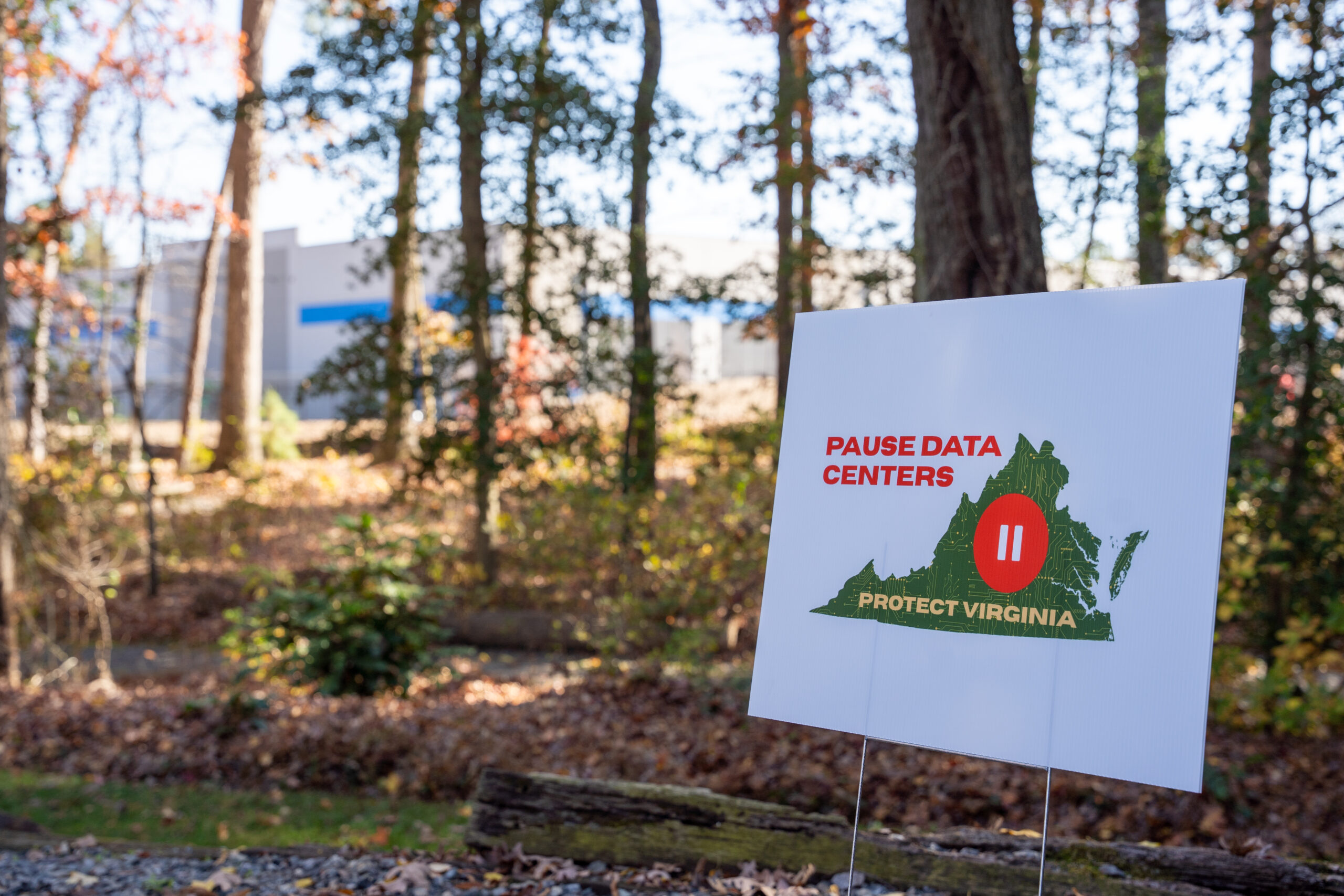
The Pause to Protect policy platform was announced beside a by-right data center built within a Hanover community. Photo by Marco Sanchez, Piedmont Environmental Council.
Virginia hosts several hundred data centers — the most in the global market. That number continues climbing, with data centers growing larger and more energy-intensive to meet the anticipated demand for artificial intelligence (AI).
Data centers are already affecting Virginians in many ways — driving up electricity bills, saddling communities with noise and harmful air pollution from diesel generators, and using significant quantities of public water resources. Without substantial new regulations, data centers will continue to pose significant risks to Virginia communities.
5 Environmental Standards that Data Centers Must Meet
Data center demand in Virginia is growing at an unsustainable pace. A coalition of Virginia Conservation Network Partners are calling for a pause on data center approvals until decisionmakers implement protections to safeguard our communities, wallets, air, water, and land.
1. Protecting Our Communities
Data centers must be good neighbors, participate in a full public hearing process–eliminating by-right approval–and disclose anticipated impacts on communities before they’re approved. Legislation must address the following:
- Data centers must be good neighbors and responsibly sited, protecting the human and environmental health of the communities they impact.
- For larger projects, data centers must undergo a full public hearing process, eliminating so-called “by right” approval.
- Developers cannot hide behind non-disclosure agreements and must fully disclose data centers’ anticipated effects on communities, natural resources, air quality, and other associated impacts.
- Virginia must accelerate its noise regulation designed for data centers, and promulgate a light pollution regulation.
- Environmental justice concerns must be top of mind during development. Data centers should not receive financial incentives for locating in historically disadvantaged communities.
- New standards on grid reliability must be developed to prevent data center-associated blackouts or excessive grid strain.
2. Protecting Our Wallets
Data centers must be made wholly responsible for paying any costs associated with their growing energy demand and should not be given lucrative tax breaks that saddle taxpayers with additional costs, absent significant reforms. Legislation must address the following:
- Homeowners, small businesses, churches, schools, and other non-data center utility customers must be shielded from any data center-related increases in electricity costs, including increased infrastructure, market, health, and environmental costs.
- New standards on interconnection to the energy grid should be developed to protect our communities and Virginia’s clean energy transition.
- Lawmakers must explore changes to current state-level tax exemptions to avoid giveaways to a billion-dollar industry absent substantial reforms.
3. Protecting Our Air
Data centers must work toward achieving 100% clean energy, limit the use of dirty diesel backup generators, and fully disclose their emissions to state regulators. Legislation must address the following:
- Data centers must commit to achieving 100% clean energy and cannot rely on harmful “behind the meter” or onsite fossil fuel power sources.
- New data centers must use backup generation that uses clean energy and does not contribute to local air pollution.
- Air permits must be strengthened and the use of polluting backup generators must be limited.
- For larger projects, there must be a detailed health analysis conducted, including on cumulative impacts – the combined, long-term effects of environmental stressors.
- Data centers must report diesel backup generator use to the Virginia Department of Environmental Quality (DEQ), which will alert the public and be able to restrict diesel use during air quality emergencies.
- The cumulative impact of any on-site or behind-the-meter polluting power sources must be subject to the Regional Greenhouse Gas Initiative, including at existing facilities.
- Emissions monitoring by data centers must be mandatory, continuous, regularly reported electronically to DEQ, and publicly available.
- State agencies must undertake forward-looking modeling that projects air quality impacts and trends.
4. Protecting Our Water
Data centers must minimize their water use and offset any local water resources they use for cooling. Legislation must address the following:
- The public’s water needs must take precedence over data center needs – including in water scarcity areas and during drought events.
- Data centers must minimize their water usage and consumption for cooling and power generation needs.
- Data centers must replenish the water resources they use.
- Data centers must treat their wastewater to remove harmful pollution, bacteria, and toxins and design sites to reduce stormwater discharges.
5. Protecting Our Land
Data centers must avoid disrupting sensitive sites like prime agricultural land, wetlands, forests, floodplains, places of historical and cultural significance, and high-value ecological habitats. Legislation must address the following:
- Data centers must avoid negative impacts to sensitive sites like agricultural land, wetlands, forests, floodplains, places of historical and cultural significance, and high-value ecological habitats.
- Data centers should not be sited close to schools, playgrounds, community centers, or daycare facilities.
- Data center projects must utilize sites that are next to support infrastructure like water collection, cooling, and energy facilities.
- The industry must fully compensate local communities that host transmission and pipeline infrastructure primarily built to accommodate data centers.
Take Action
Dozens of environmental organizations are calling on decisionmakers to pause data center development to protect Virginia. Your voice matters: speak up through the Pause to Protect Action Center!
Statements from the Community
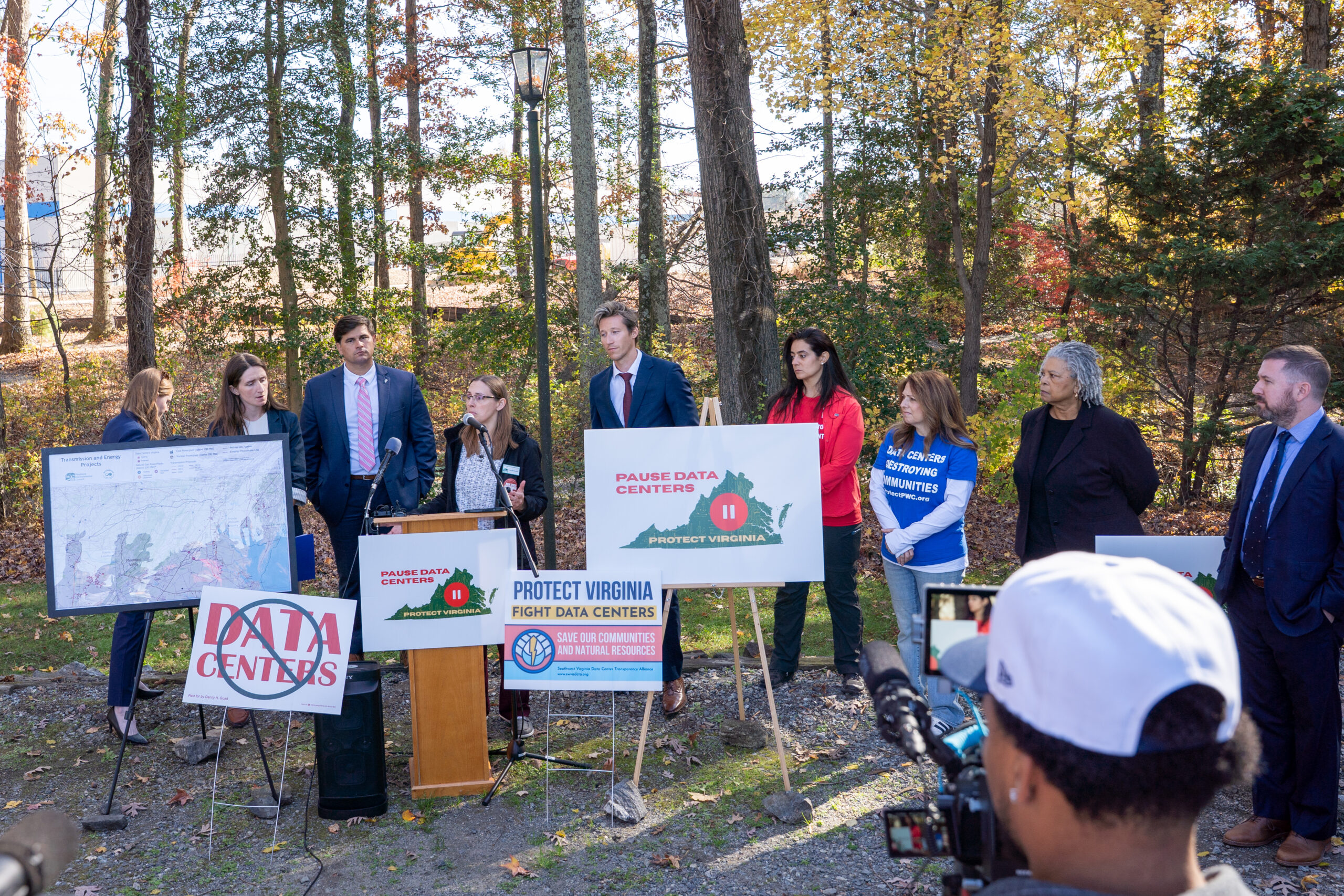
Environmental organizations and community members announce the Pause to Protect policy platform outside of a by-right data center built within a Hanover community. Photo by Marco Sanchez, Piedmont Environmental Council.
Virginia Conservation Network Partners and other stakeholders released the following statements Supporting the Pause to Protect policy platform. Check back for more statements.
Last updated on November 13th, 2026.
Virginia Conservation Network
“The Pause to Protect policy platform will make meaningful progress to reduce and mitigate the growing impacts data center development is having on communities, our natural resources, and Virginia’s energy system. We look forward to working with the Administration, General Assembly, and our Partners to pass all components of the Pause to Protect Platform, starting with a pause of data center development until regulations and standards are clearly in place and enforced to protect our communities, wallets, air, land, and water.”
– Jessica Sims, Executive Director

Allegheny-Blue Ridge Alliance
“Data center growth isn’t just a Northern Virginia problem. Rural communities like those in Botetourt County, VA, and Davis, WV, are being asked to absorb new facilities, along with the transmission lines, pipelines and power plants that feed them. All this puts headwater streams, groundwater, prime farmland and family budgets at risk. Virginia should not be speeding this build-out with tax breaks that ordinary ratepayers and taxpayers will ultimately pay for, especially when an over-built industry is likely to leave behind obsolete facilities for reluctant host communities to clean up. We need a pause until strong, enforceable standards are in place to protect our communities, our natural resources and our wallets.”
– Dan Shaffer, Executive Director

American Rivers
“Absent transparency about planned and actual impacts, Virginia communities commonwealth-wide are left only to speculate on the extent to which existing and planned data center demands will actually impact our local rivers, communities, and businesses. Particularly amid a prolonged drought with record-low river flows, state legislators have the distinct and limited opportunity to require both transparency and meaningful accountability of data centers to ensure all Virginians are fully equipped to both consider and to rein in the cumulative risks of water consumption, stormwater runoff, and wastewater pollution to their own communities posed through this unique and unprecedented scale of industrial expansion across our landscapes.”
– Pat Calvert, Virginia Director of Conservation

Appalachian Voices
“Data centers already have an outsized impact on Virginians’ lives and well-being. With explosive industry growth expected to continue, the harmful effects will also explode unless our elected leaders enact strong protections. We have the policy and technology solutions to protect our air, land, water, communities, and wallets. But until those protections are secured and common-sense guardrails are fully in place, we should not make matters worse by permitting any new data centers.”
-Matt Allenbaugh, Virginia Campaign Coordinator

Chesapeake Bay Foundation
“The wealthiest companies in human history think Virginians should shoulder higher energy bills, breathe dirtier air, and have less access to clean water so these same companies can build data centers. Enough is enough. We need a pause to protect Virginians from further harm from these runaway AI factories.”
– Jay Ford, Virginia Policy Manager

Chesapeake Climate Action Network Action Fund
“With Pause to Protect, we are asking lawmakers to put people over corporate profit. Virginians have been asked to sacrifice far too much to benefit Big Tech – our planet, our health, our wallets. We need to take a breath and use this pause to thoughtfully implement commonsense protections for communities and our environment before it is too late.”
– Victoria Higgins, Virginia Director

Chesapeake Legal Alliance
“Virginia’s data center boom is happening faster than our laws can keep up, and the world’s wealthiest companies are asking Chesapeake Bay communities to bear the consequences. Data centers clear forests and pave over farmland that once filtered polluted runoff. Data centers suck up large amounts of water to cool their servers, withdrawing from the same rivers, streams and aquifers that feed the Bay and supply drinking water to Bay communities. Right now, no statewide framework makes anyone look at these impacts together. Project-by-project approvals add up to cumulative harm that no single permit ever accounts for. “Pause to Protect” gives Virginia a chance to catch up. Critically, it provides a chance to plan: to require full disclosure and accounting of water use, to protect streamflows during drought, to hold developers to strong stormwater and land-conservation requirements, and to give affected communities a real voice before permits are issued, not after. Virginians deserve laws that protect clean, plentiful water for the people and wildlife of the Bay watershed, not just for the data center industry’s bottom line.” – David Reed, Executive Director
“Virginia’s data center boom is happening faster than our laws can keep up, and the world’s wealthiest companies are asking Chesapeake Bay communities to bear the consequences. Data centers clear forests and pave over farmland that once filtered polluted runoff. Data centers suck up large amounts of water to cool their servers, withdrawing from the same rivers, streams and aquifers that feed the Bay and supply drinking water to Bay communities. Right now, no statewide framework makes anyone look at these impacts together. Project-by-project approvals add up to cumulative harm that no single permit ever accounts for. “Pause to Protect” gives Virginia a chance to catch up. Critically, it provides a chance to plan: to require full disclosure and accounting of water use, to protect streamflows during drought, to hold developers to strong stormwater and land-conservation requirements, and to give affected communities a real voice before permits are issued, not after. Virginians deserve laws that protect clean, plentiful water for the people and wildlife of the Bay watershed, not just for the data center industry’s bottom line.”
– David Reed, Executive Director

Clean Virginia
“For far too long, Virginia’s energy policy has been driven not by the public interest, but by corporate profits. The unchecked expansion of data centers is a prime example of that injustice. Big Tech companies, monopoly utilities, and corporate polluters are reaping the rewards of this industry while Virginia families are paying the price through rising costs and escalating health and environmental impacts. Before Virginia commits to decades of data center development, we must hit pause and put meaningful, enforceable protections in place for the communities who bear the burden.”
– Brennan Gilmore, Executive Director

Friends of the Rappahannock
“The unrestricted growth of the data center industry is overwhelming our communities and natural resources. Due to a lack of a statewide framework we must pause all new data center construction until proper protections are enacted.”
– Brent Hunsinger, Advocacy Director

James River Association
“We are deeply concerned about the ever-growing impacts of rapid data center expansion on our rivers and water resources. The combined pressure of data centers and the likewise growing network of power plants, transmission lines, and overall landscape change can threaten water quality through increased runoff, erosion, and pollution and further increasing demands on strained water supplies. Virginia needs to pause and consider these cumulative impacts, particularly as climate change and drought place mounting pressure on our rivers and streams. A temporary pause would provide time to establish stronger protections to safeguard clean water and healthy rivers.”
– Tom Dunlap, James RIVERKEEPER™

National Parks Conservation Association
“Data centers are one of the biggest threats facing Virginia national parks and public lands across the Mid-Atlantic region. Today, there are more data centers in our state than any other location on Earth and that should alarm every Virginian. The explosive, unchecked growth of data centers and the enormous physical footprint they require takes a considerable toll on our way-of-life here. This is not the future we want for our communities and our beloved national parks like Manassas and Shenandoah. Enough is enough. NPCA is calling for common sense reforms and supports a state-wide pause on any data center development until our elected officials make meaningful laws to address responsible growth, long-term planning and enforce transparent processes that include robust public engagement.”
– Kyle Hart, Mid-Atlantic Senior Program Manager

Nature Forward
“We can’t continue rolling out the welcome mat for data center developers at the expense of communities and the environment that sustains us. Virginians are already dealing with the negative impacts of the data center build-out, from cumulative air pollution to constant noise and fractured natural and human communities—all done with little transparency. Reliance on more dirty fossil fuel power generation, with scars on the land from their transmission lines, further puts communities at risk. We need meaningful, state-wide protections in place before another data center is built here.”
– Renee Grebe, Northern Virginia Conservation Advocate
Piedmont Environmental Council
“We need a moratorium to provide time to develop and implement regulations to protect the lives and livelihoods of all Virginians. Without a moratorium, the state will continue to allow unprecedented levels of fossil fuel use, construction of high voltage transmission lines and pipelines far removed from data centers, increasing utility bills to pay for this generation and transmission, and installation of thousands of diesel generators and gas turbines on data center sites in neighborhoods to supplement power from the grid. Virginia communities are tired of having the largest data center market in the world but being told they can’t require more of the industry. It’s time to stop being the example of what not to do, get strong standards in place, and become sustainability leaders.
– Chris Miller, President

Potomac Riverkeeper Network
“For more than 25 years, Potomac Riverkeeper Network has protected and defended the public’s right to clean water. The rapid proliferation of data centers, particularly in Northern Virginia, is increasing uncertainty and demand on our surface and groundwater resources. The Potomac River, the sole drinking water source for DC and Arlington, is already at risk for water shortages as persistent drought conditions have continued over the last two years. If we allow unchecked growth, we increase the uncertainty around our access to drinking water. We risk the streamflows required for recreating and protecting sensitive habitat. Transparency and regulation are vital to protect the millions of people that live and rely on the Potomac.”
– Betsy Nicholas, President

Sierra Club Virginia Chapter
“The data center industry is polluting our air, depleting our water resources, driving up electricity bills, and forcing Virginia communities to bear the costs of unchecked development. Enough is enough. Virginia must press pause on data center development and pass strong, enforceable protections to safeguard our health, our environment, our communities, and our wallets. Virginia faces a critical choice: continue giving multitrillion-dollar tech companies a free pass or put Virginia families first – there is no inbetween. This upcoming session, we look forward to working with lawmakers to get the job done.”
– Tim Cywinski, Communications Director

Solar United Neighbors of Virginia
“The rapid expansion of data centers is changing how electricity is generated and consumed in the Commonwealth. Virginia solar supporters are rightly concerned these changes could impinge on our right to go solar by locking us into using expensive, centralized energy sources. A data center construction pause will create a space to make sure that Virginia builds an affordable energy system that benefits everyone.”
– Brandon Praileau, Virginia Program Director

Southern Environmental Law Center
“Virginians struggle with skyrocketing electricity bills while data centers continue to get a sweet deal. Virginians are being asked to jeopardize their health because utilities plan to build harmful gas plants to power data centers. Virginians face increasing risk of drought while data centers reach deals for massive water withdrawals. Despite the glossy TV ads, Virginians know the truth: data centers aren’t paying their fair share and they aren’t good neighbors. ‘Pause to Protect’ gets us back on track. Virginia is going to define what it means to be a good neighbor and what it takes to do business here—not the industry that is actively harming Virginians.”
– Nate Benforado, Senior Attorney
Virginia Interfaith Power & Light
“Data center growth has gone too long and too far without guardrails to protect Virginia families’ pocketbooks, health outcomes, and overall quality of life. A pause will give legislators and decision-makers time to incorporate the concerns the vast majority of Virginians share about data center encroachment in their neighborhoods and wallets. The goal is to ensure justice and benefits for communities across Virginia.”
– Faith Harris, Executive Director
Virginia League of Conservation Voters
“After years of unchecked development, data centers are impacting every corner of the Commonwealth – driving up our energy bills, polluting communities, and impacting quality of life. Enough is enough – we need to pause data center approvals now, until we have the protections in place that hold Big Tech accountable and put Virginians first.”
– Blair St. Ledger-Olson, Director of Advocacy & Campaigns

York River Stewards
“Through this pause, we are providing protection to the natural resources and people affected by the current uncontrolled data center expansion across Virginia’s landscape.”
– Leslie Anne Hammond, York River Steward